
AdVenture Capitalist
Hyper HippoSimulation
4.5346.00K Reviews
- Version
- 9.26.1
- Installs
- 10.00M
- Age Rating
- Everyone
Screenshots






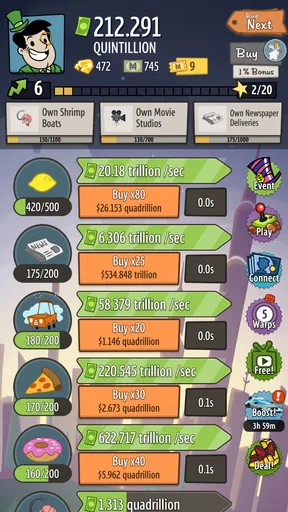

Our Review of AdVenture Capitalist
 Analysis by Appyee
AdVenture Capitalist is the kind of simulation game I open when I want progress without having to give it my full attention. I start with a tiny lemonade business, tap through the first opportunities, hire managers, and gradually turn a simple stand into a much larger operation. The appeal is not realism; it is the satisfying rhythm of making a decision, watching income increase, leaving the game for a while, and returning to collect the results.
After spending time with it, I see why this free game from Hyper Hippo has remained popular for so long. It is easy to understand within minutes, but its upgrade choices create enough small decisions to keep the early and middle stages interesting. At the same time, its idle structure can become repetitive, and the presence of optional purchases means the experience is not equally comfortable for every player. My recommendation depends heavily on whether you enjoy gradual number growth more than direct control or story-driven play.
How the current version feels to play
The current release is version 9.26.1, and the game remains focused on its original idle-business loop rather than trying to become a traditional management simulator. The opening is deliberately simple: produce lemonade, improve the business, and use the earnings to unlock more ways to make money. That simplicity is useful because I never had to learn a complicated interface before understanding what mattered.
The screen is built around short decisions. I can invest in an upgrade, activate a manager-like improvement, or wait for accumulated earnings to make the next purchase possible. The important choice is often not whether I can buy something, but which purchase will improve the whole operation most efficiently. That makes the game approachable for casual players while still giving experienced idle-game fans a reason to think about timing.
Its category is simulation, although I would describe it more precisely as a playful incremental business simulator. It does not ask me to manage staff schedules, negotiate contracts, or respond to a changing market. Instead, it turns business growth into a sequence of visible milestones. The pleasure comes from optimization and momentum, not from pretending to run a company in a detailed economic world.
The game is free to download and rated for Everyone, which makes it easy to try on a shared family device or recommend to someone who has never played an idle title. It supports Android 7.0 and later. On the store, it has an average rating of 4.5 from around 1.6 million ratings and has passed 10 million installs, so it is clearly not an obscure experiment. Those figures also match my impression that the game is designed for a broad audience rather than a small group of strategy specialists.
The first session teaches the loop quickly
My first useful lesson was that tapping is only the beginning. Manual tapping helps establish the business, but the long-term flow depends on improving automatic production. Once the operation begins earning while I am away, the game changes from an active clicking exercise into a planning routine. I check what has accumulated, spend it where the next improvement is strongest, and decide whether to keep playing or return later.
That transition is one of the smartest parts of the design. A pure clicker can become tiring because every gain demands another tap. Here, the early interaction introduces the theme, while automation becomes the reason to continue. I still have something to do when I am present, but I am not punished for putting the phone down.
A practical way to play is to avoid spending every available coin immediately. I usually look at the cost of the next meaningful milestone and keep enough funds to reach it rather than scattering small purchases across several businesses. This creates a clearer sense of direction. Buying whatever flashes as affordable feels active, but saving for a threshold often produces a more noticeable change in the pace of progress.
What has changed over the life of the game
AdVenture Capitalist was released on February 18, 2015, and its age is important when judging the current experience. This is not a newly launched idle game still searching for its identity. The long-running version has had time to settle into a recognizable structure, and the current release presents that established formula rather than a radical reinvention.
I would be careful about expecting every update to transform the game. The verified current version tells me where the app stands now, but it does not justify assuming that a particular update added a specific feature or changed a particular balance value. What I can say from using the present build is that the central progression remains clear: build income, reinvest it, automate more of the work, and pursue larger milestones.
That stability is good news for returning players. Someone who enjoyed the game years ago should not need to relearn an entirely different product just to understand the current menus and progression. It also explains the downside: players hoping for a fresh management challenge may find that the familiar loop is still the main event. The game has evolved into a polished version of its concept, not into a completely different genre.
Hyper Hippo’s design approach is visible in the tone as well as the mechanics. The business theme is exaggerated and humorous, which keeps the escalating numbers from feeling too dry. I never felt that the game was asking me to take its fictional economy seriously. That makes it more welcoming than a spreadsheet-heavy simulator, though it also means that players seeking realistic financial decisions should look elsewhere.
Why the idle system works in everyday use
The best everyday scenario is a short break during a busy day. I can open the game, collect accumulated earnings, make one or two upgrades, and close it again without losing the thread. There is no need to remember a complex quest chain or prepare for a difficult battle. The game turns a spare minute into a small planning session.
It also suits people who like checking progress at natural intervals. I might play before leaving home, return during a lunch break, and look again in the evening. Each visit has a simple purpose: see what the business earned, identify the next useful improvement, and decide whether the current reward is worth reinvesting. That routine is more satisfying than constantly tapping because the waiting period becomes part of the strategy.
One less obvious strength is that the game can function as a low-pressure introduction to incremental design. It demonstrates compounding progress in a very readable way. An improvement that seems modest at first can matter more after several related upgrades, and automation changes the value of time. I would not call it a finance lesson, but it does make the relationship between reinvestment and growth easy to feel.
The trade-off is that the same convenience can reduce urgency. If I am looking for a game that demands quick reactions, careful positioning, or a meaningful decision every few seconds, this is not the right choice. The idle system is intentionally forgiving. Missing a session does not create the kind of setback found in competitive or action-focused games, but it also means the emotional highs are quieter.
How I approach upgrades without wasting momentum
The most useful habit is to distinguish between an upgrade that merely adds a little income and one that changes the pace of the whole business. Early on, I prefer improvements that help several parts of the operation rather than repeatedly boosting only the most visible source. This keeps the business balanced and makes later purchases feel less disconnected.
I also treat the interface as a planning tool instead of a list of buttons. Before buying, I check what the next unlock requires and whether a cheaper purchase will delay it without offering a meaningful benefit. That small pause prevents a common idle-game mistake: spending because something is available rather than because it supports a goal.
Another useful approach is to separate active play from return visits. When I have time, I use tapping and rapid purchases to push toward a milestone. When I am busy, I let the automated side do the work and come back later. Trying to play both ways at once can make the game feel unfocused, while switching deliberately makes each session easier to understand.
Players should also remember that the game is built around repetition. Resetting or restarting a progression layer, where the game presents that option, should be treated as a strategic decision rather than a failure. The value is in trading short-term progress for a stronger future run. I would only do this when the permanent or long-term benefit is clear enough to justify losing the current momentum.
Where the free model creates friction
The free entry point is a genuine advantage, but the game includes in-app purchases ranging from $0.49 to $99.99 per item. I can play without buying, yet the existence of those options changes how I evaluate the pacing. A player who wants the fastest possible progress may feel pressure to pay, while someone comfortable with waiting can treat purchases as optional conveniences.
My advice is to decide in advance what kind of experience you want. If the goal is a relaxed idle game, ignore the store and accept that progress is measured in return visits. If the goal is to accelerate every stage, the free structure may feel restrictive. The important point is not that purchases exist, but that they can alter the emotional balance between patience and spending.
There is also a psychological cost to constant optimization. Once I start comparing every upgrade and waiting for the best return, the playful lemonade theme can start to feel like a checklist. This is where I recommend taking breaks instead of treating the game as a daily obligation. It works best as a small habit, not as a task that must be completed perfectly.
Another limitation is the lack of deep simulation detail. The game does not give me the kind of market uncertainty, supply problems, or customer behavior that I would expect from a serious business simulator. That is not a flaw if the goal is casual incremental play, but it is a clear boundary. The word “capitalist” is part of the joke and theme; it should not be read as a promise of realistic economics.
Who will enjoy it, and who should skip it
I would recommend it to players who enjoy watching systems grow, making small efficiency choices, and checking a game several times instead of playing one long uninterrupted session. It is especially suitable for someone who wants a low-stress title that can be understood quickly and paused at any moment. The Everyone rating also makes it a broadly accessible option for families and younger players, although adults should still be aware of the optional purchase structure.
It is a good fit for fans of incremental games who enjoy the moment when automation takes over from manual effort. The progression is readable, the theme is light, and the game does not require reflexes. It can also work for someone who wants a gentle introduction to the genre before trying more complicated idle games with deeper systems.
I would skip it if you need a strong narrative, competitive multiplayer, or constant tactical pressure. I would also choose a more detailed business simulator if the fun comes from analyzing realistic costs, staffing, pricing, and market conditions. AdVenture Capitalist simplifies those ideas into a cheerful growth machine. That is its identity, not something it accidentally fails to be.
Compared with a traditional clicker, it gives more structure to the business fantasy and makes automation central rather than leaving the player tapping indefinitely. Compared with a full management simulation, it removes most of the difficult operational detail. In my view, it sits comfortably between the two: more purposeful than a bare tapping toy, but much lighter than a serious economic model.
Questions I had after returning to it
One question is whether it is still worth starting now. I think it is, provided you are comfortable with a mature game whose appeal comes from gradual accumulation rather than novelty. The current version is stable in its identity, and a new player can understand the basic loop quickly. I would not begin expecting a short campaign with a definite ending; I would begin expecting an ongoing progression hobby.
Another question is whether it requires constant internet attention or continuous tapping. In practical terms, the design is built around idle progress, so the point is to let the business continue while you are away and return when convenient. I still prefer to open it regularly when I want faster advancement, but it does not make sense to treat it like an action game that demands uninterrupted input.
People also often wonder whether spending is necessary. My experience is that the game can be approached as a free title if patience is part of the fun. Purchases are more relevant to players who want to shorten waiting or move through progression quickly. If optional spending makes you uncomfortable, the safest approach is to ignore the shop entirely and judge the game by its unhurried loop.
Finally, is it suitable for a phone with an older operating system? The stated minimum is Android 7.0, so anyone using an earlier Android release should not assume compatibility. For supported devices, the modest, menu-driven nature of the game makes it a more practical casual choice than a demanding action title, especially when the aim is to check progress briefly.
What I would watch before committing long term
For existing players, the main thing to watch is how future releases affect the balance between active input and idle earnings. That relationship determines whether returning at sensible intervals still feels rewarding or whether progress increasingly favors constant checking. Because the game’s appeal depends on a comfortable rhythm, even small pacing changes could affect the experience more than a cosmetic adjustment.
I would also pay attention to how clearly new or returning players can understand their next goal. Idle games become frustrating when the screen offers many possible purchases without explaining which one matters. The current structure is approachable, but long-term enjoyment depends on keeping the path from one milestone to the next readable.
For anyone considering an installation today, my practical recommendation is to play the opening without spending money. See whether the repeated cycle of collecting, upgrading, and waiting feels satisfying after the initial novelty disappears. If it does, the game can become a pleasant background hobby. If the loop already feels slow or repetitive, paid acceleration will not solve the underlying mismatch.
Overall, AdVenture Capitalist succeeds because it understands exactly what it wants to be: a friendly, exaggerated idle business game with a very low barrier to entry. Its strongest feature is the way it turns a few minutes of attention into visible progress later. Its weakest point is the same repetition that makes it relaxing. I recommend it to patient players who like incremental growth, but I would steer action fans and serious simulation enthusiasts toward something more demanding.
My final verdict is positive with a clear condition: enjoy the waiting as much as the upgrading. Hyper Hippo’s game is free, accessible, and easy to fit around ordinary routines, with a 4.5 average and a large established audience behind it. Just keep the purchase options in perspective, set your own pace, and remember that the fun comes from building momentum—not from rushing to the biggest number as quickly as possible.
Verdict
Strengths of AdVenture Capitalist
- Simple idle gameplay that is easy to understand from the first minute.
- Progress continues while offline, even when you are not actively playing.
- Many businesses and upgrades create a satisfying sense of progression.
- Lighthearted humor and colorful visuals give the game plenty of personality.
- Runs smoothly on most modern Android and iOS devices.
Limitations of AdVenture Capitalist
- Progress can feel repetitive once the initial excitement wears off.
- Frequent ads may interrupt play unless you choose to watch them for rewards.
- Some upgrades and boosts encourage spending premium currency or real money.
- Later stages require long waiting periods or frequent check-ins to advance.
- The game offers limited challenge for players seeking strategic depth.
Other Releases by Hyper Hippo
View All
AdVenture Communist
Simulation4.3

AdVenture Ages: Idle Clicker
Simulation4.3
Similar Picks in This Category
View All
Truckers of Europe 3
Wanda Software4.3

Town Building Life Simulator
XGame Global4.2

Fidget Toys Trading・Pop It 3D
Freeplay Inc4.7

Sculpt People
CrazyLabs LTD4.4

Scary Teacher 3D
Z & K Games4.2

Hair Tattoo: Barber Shop Game
CASUAL AZUR GAMES4.3
Frequently Asked Questions
What is AdVenture Capitalist and how does the gameplay work?
AdVenture Capitalist is an idle business simulation game in which you begin by selling lemonade and gradually build a huge virtual empire. You tap or activate businesses, hire managers to automate production, and reinvest profits into upgrades. Once automation is established, the game continues generating money while you are away, making it suitable for players who enjoy gradual progress rather than constant, action-focused gameplay.
Can I play AdVenture Capitalist without an internet connection?
The game may allow some progress and basic business management while offline, but an internet connection is generally useful for synchronizing your account, receiving updates, accessing events, watching optional advertisements, and using online features. Offline earnings may also be calculated differently from active play. If you plan to switch devices or protect your progress, connecting the game to its supported account or cloud-saving option is recommended.
Is AdVenture Capitalist free to download and play?
AdVenture Capitalist is generally free to download, but it includes optional in-app purchases and advertising. You can progress without spending money, although purchases may provide premium currency, boosts, or convenience features that accelerate development. The game is designed around repeated upgrades and waiting periods, so players who prefer a completely uninterrupted experience should review the available purchase options and advertising settings before starting.
Does AdVenture Capitalist contain ads or in-app purchases?
Yes, AdVenture Capitalist can include optional advertisements and in-app purchases. Ads may offer useful rewards such as temporary multipliers or additional bonuses, while purchases can provide premium currency and other progression benefits. Neither is necessarily required to enjoy the core game, but they can influence how quickly your businesses grow. Parents should also check device purchase restrictions if children use the device.
Is AdVenture Capitalist suitable for casual players and children?
AdVenture Capitalist is easy to understand and does not require fast reflexes, so it can suit casual players who enjoy management, incremental progress, and short check-in sessions. However, it includes virtual currency, optional purchases, advertisements, and themes involving money-making and business expansion. Parents should review the game’s age rating and configure parental controls, especially if the device is shared with younger players.
Play our best games!


